










To advance digital transformation for the built environment through the delivery of consensus- based industry standards, research, and thought leadership focusing on value-driven outcomes.
To convene industry to adopt and empower transformative digital technology strategies across stakeholders, raising the bar for professional services, that drive improved project delivery and operational processes.
Priority-Establishing a “digital project delivery approach” as the new normal for leveraging technology industry standards to drive the most efficient and mutually beneficial stakeholder outcomes. Educate and Elevate the body of workforce.
Priority-Promote the connection between digital and physical environments through advanced technology tools that can survey, gather, analyze, and perform work to increase productivity, eliminate waste and supplement our workforce.
Priority-Define, and Deliver a framework and output for practical digital twin implementation across the project lifecycle.
The five-member Digital Technology Council (DTC) Board of Direction (BOD) provides vision, leadership, and operational guidance for the Council while ensuring effective management of resources to advance the vision of the Council.
Officers are elected from within the council membership through a nominations and election process.
McCarthy Building Companies, Inc.
Salas O’Brien
Kaiser Permanente
Black & Veatch Corportation
MOREgroup
Board Advisor, ViaTechnik
EMF Collaborative
Virtual Intros; Aquila Loop
Program Director, Digital Technology
Senior Associate, Digital Facilities Integration

“It is an honor and privilege to help serve the mission of NIBS and the supporting work of the Digital Technology Council to rally AECO industry stakeholders together to reach the next level of digital transformation for the built environment. We are at a critical juncture in the modern era where the intersection of technology evolution and business value must become more closely integrated to reach the next destination of digital maturity for our industry. From expanding upon our origins of defining BIM as a core technology and enabler of digital delivery, and by engaging our community of industry experts to expand this work, we aim to bring together tangible ideas and timely benefit to elevate the impact technology can have to connecting people, process and their data needs.”

“The Digital Technology Council brings together a uniquely diverse group of AECO leaders in support of the broader NIBS mission. Under the enabling legislation, Public Law 93-383, we are strategically positioned to help guide how digital practices evolve across the built environment. Member participation is vital to strengthening the impact of the DTC’s work. I am honored to support NIBS mission and look forward to welcoming more voices into the Council’s committees. ”

The National BIM Standard-United States® (NBIMS-US™) provides consensus-based standards through referencing existing standards, documenting information exchanges and delivering best business practices for the entire built environment. With open BIM standards, we can build detailed models and deliver accurate products that can be used during commissioning and operation to ensure facility functionality throughout the life of the facility and to deliver high performance, carbon neutral, and net zero energy based facilities.
The NCS is a consensus standard incorporating industry publications. It is comprised of interrelated standards, guidelines and tools for uniformly organizing and presenting facility drawing information. It is the only comprehensive standard for facility planning, design, construction and operation drawings. The NCS consists of The American Institute of Architect’s CAD Layer Guidelines, Construction Specifications Institute’s Uniform Drawing System (Modules 1-8), and National Institute of Building Sciences’ BIM Implementation & Plotting Guidelines.
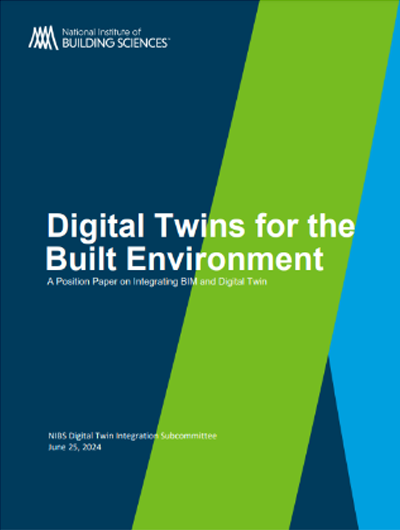
This position paper, written and published by the NIBS Digital Twin Integration Subcommittee (DTI-S), encourages the integration of Building Information Modeling (BIM) and Digital Twin technology, presenting a groundbreaking opportunity for the architecture, engineering, construction, and operations (AECO) industry. This integration sets the stage for innovation, efficiency, and collaboration and envisions a future where BIM and Digital Twin coexist and synergize to drive sustainability and enhance operational performance. By identifying this opportunity, the DTI-S offers the industry a plan for advancement that leverages the full spectrum of digital capabilities. This paper showcases how through strategic integration, leaders, technologists, and AECO practitioners can accelerate significant industry-wide change and engage in informed decision making. [June 2024 / 54 pages]
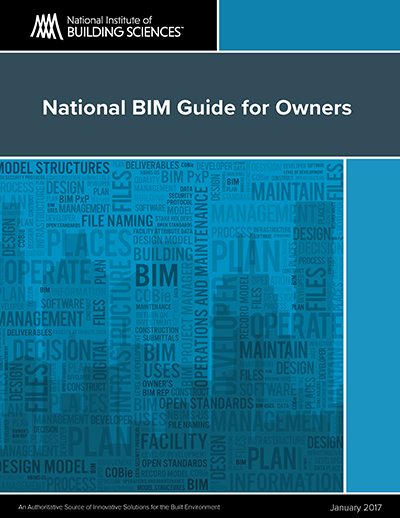
The purpose of the National Building Information Modeling Guide for Owners (NBGO) is to outline for the building Owner how to develop and implement requirements for the application of Building Information Modeling (BIM) for internal policies and procedures, and explain how to include these requirements in contracts to plan, design, construct and operate buildings. This Guide uses the term “building” generically, in keeping with the terminology of “Building Information Modeling.” It is intended to apply to information modeling for the built environment: site elements and facilities as well as buildings.. [January 2017 / 36 pages]
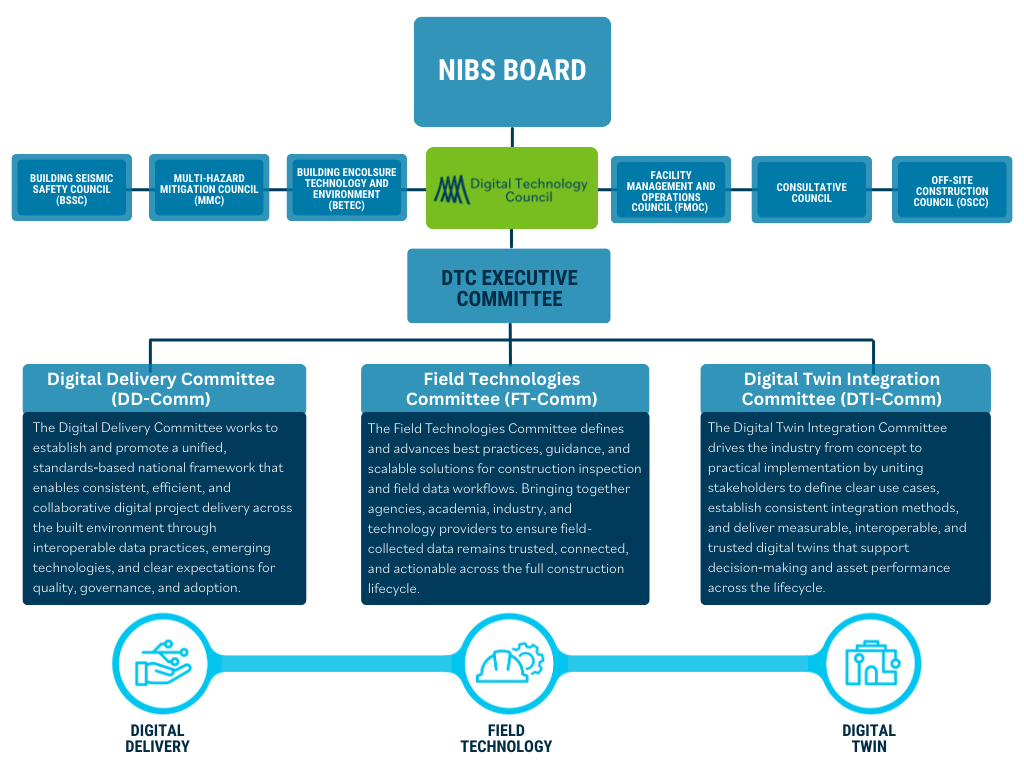
Committees established by the Digital Technology Council (DTC) Executive Committee (ExCom) serve at the discretion of the DTC ExCom. DTC committees shall be utilized by the DTC ExCom to examine specific topics in need of attention.
The Digital Delivery Committee will develop and maintain a national, standards-based digital delivery framework for the built environment, defining minimum requirements, governance practices, and implementation guidance to enable interoperable, lifecycle data exchange across planning, design, construction, commissioning, and operations. The committee’s scope includes advancing NCS and NBIMS evolution guidance, establishing digital twin delivery requirements, defining protocols for AI-enabled project delivery, and aligning workforce competencies and terminology to support consistent adoption. The committee will coordinate related standards, guidance, research, and industry engagement activities to support repeatable implementation across stakeholder group.
Chair: Jacob D-Albora
Secretary: Pouyan Layegh
The Digital Twin Integration Committee focuses on helping the industry move from concept to practical implementation of digital twins by aligning strategy, standards, adoption, and measurable outcomes. The committee brings together owners, practitioners, researchers, and technology providers to define clear use cases, establish consistent integration approaches, and demonstrate defensible value across the asset lifecycle. Its work is centered on reducing uncertainty, improving interoperability, and enabling digital twins to function as trusted operational tools that support decision-making, performance, and long-term asset management.
The Digital Twin Integration Committee will develop guidance, frameworks, and industry resources that support the successful adoption and integration of digital twins across the asset lifecycle. The committee’s work will address core areas including strategy, standards alignment, organizational adoption, governance, performance measurement, and value realization. It will coordinate with related committees to ensure digital twin approaches align with digital delivery practices, field technologies, and lifecycle data continuity, while producing practical guidance, case studies, and measurable frameworks that enable consistent, scalable implementation across asset types and industries.
Working Group 1: Strategy and Framework
Working Group 2: Adoption and Change Management
Working Group 3: ROI and Perceived Value
The DTI-C is dependent upon the voluntary efforts of its members to collaboratively engage with the drafting of documents and prototyping of tools, to review the products of other efforts within and around the DTI-C and participate as liaisons with groups deemed significant and relevant by the DTI-C. Industry participation is especially important because the alignment between them and a national standard will streamline development efforts between the BIM and Digital Twin communities. This further fosters improvements in the speed and efficiency with which individual, organizational, and industry efforts reach full maturity and ubiquity. Government agency participation is similarly critical to ensuring a more manageable communication effort between vendors and the Government alike. This improves contract oversight, ensures that right-sized solutions are available in the market, and that Government agency strategies can be aligned with a degree of certainty on the state and direction of the market. This participation may be supplemented by funded resources in alignment with the annual planning cycle.
The DTI-C will identify organizations, firms and government agencies which are likely to benefit from the clear and defined integration of BIM and Digital Twin disciplines. It will rely on the assistance of NIBS in encouraging participation in and support of the workgroup as it works to facilitate, foster, and maintain industry engagement.
The Field Technologies Committee exists to define and advance best practices, guidance, and scalable solutions for construction inspection and field data workflows, bringing together agencies, academia, industry, and technology providers to ensure field-collected data remains trusted, connected, and actionable across the full construction lifecycle.
The Field Technologies Committee focuses on practical, real-world implementation of field technologies across transportation and vertical construction, evaluating how inspection, geospatial, and data capture workflows integrate with digital delivery, BIM/VDC, GIS, asset management, and digital twin initiatives to ensure data quality, workforce readiness, and scalable adoption.
Program Director, Digital Technology
National Institute of Building Sciences
NIBS COUNCIL MEMBERS ARE A PART OF THE COMMUNITY DRIVING IMPROVEMENTS IN THE BUILT ENVIRONMENT.